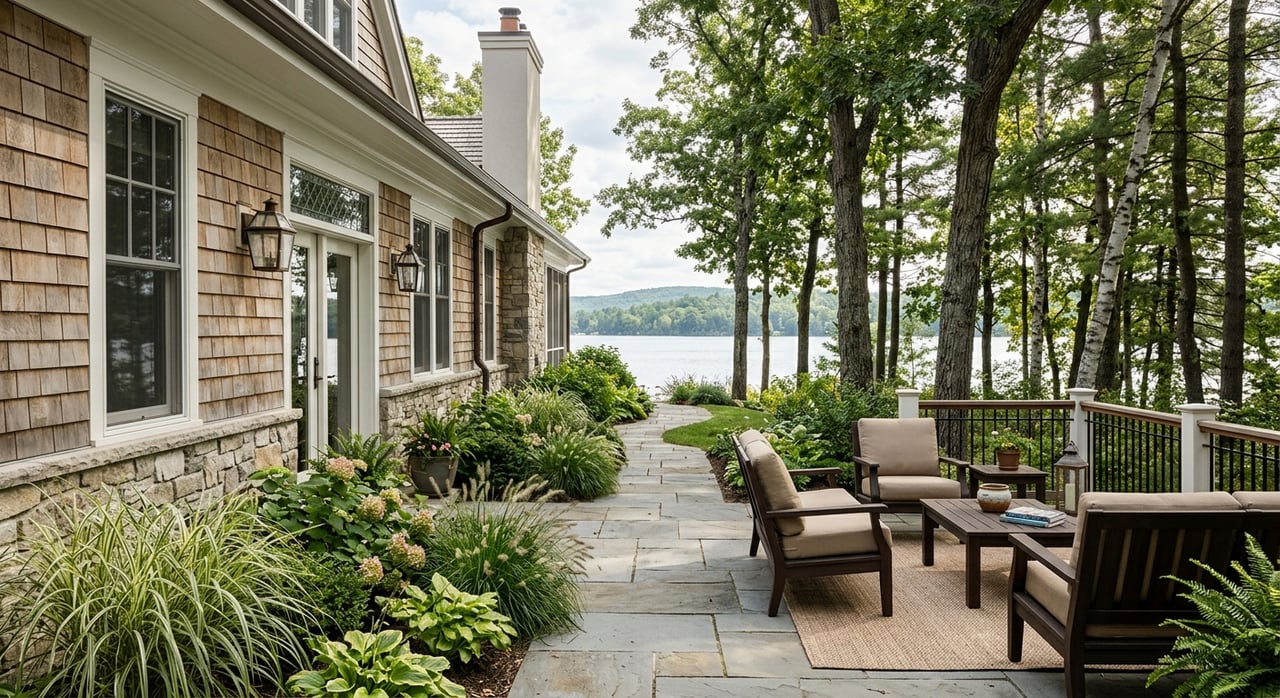
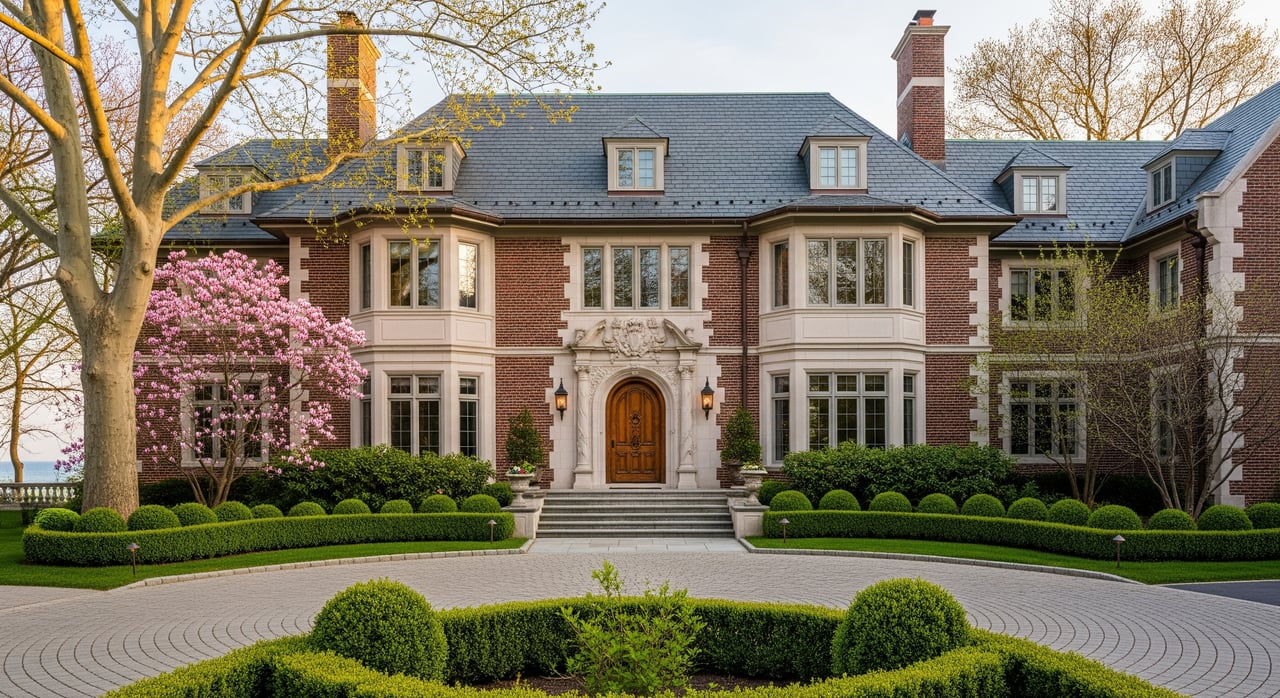
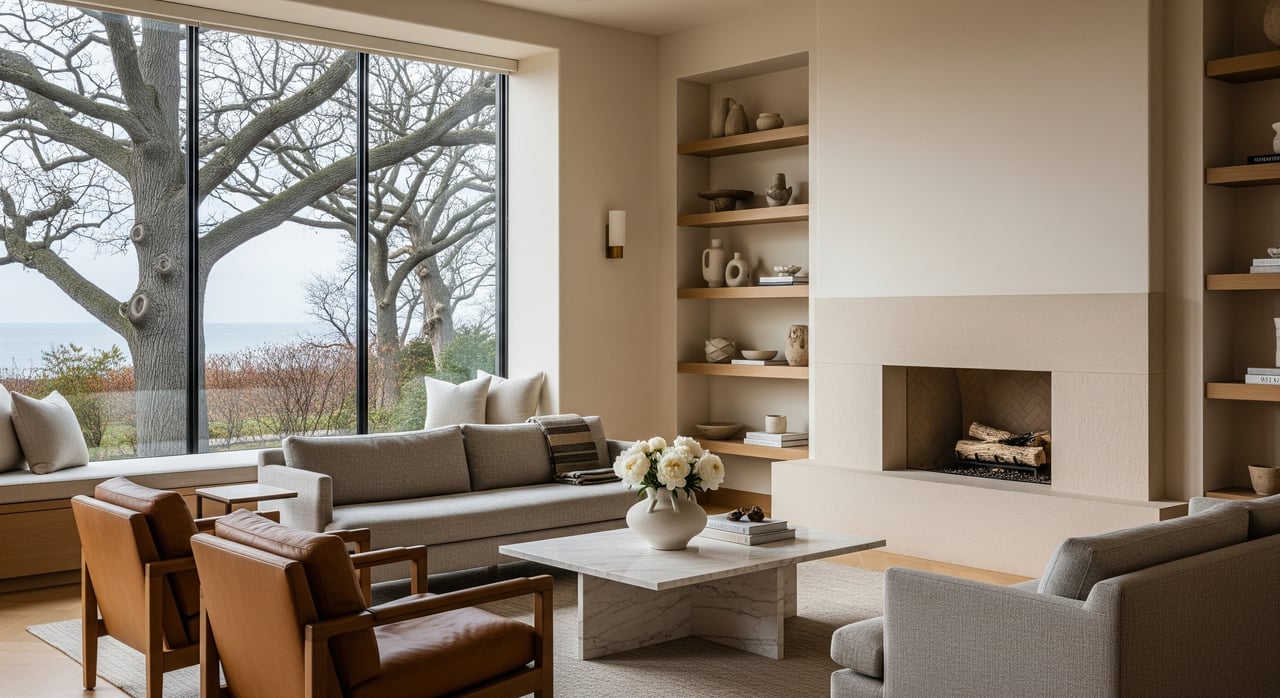
A lakefront lot on Sheridan Road used to follow a familiar logic. The house mattered less than the land, and the land's value climbed with what you could clear and rebuild. Since February 2024, that logic has flipped. On Winnetka's bluffs, a structure that already exists is worth more intact than the same square footage would be if you were proposing to build it fresh. That is not a market quirk. It is the direct, engineered result of a Village ordinance, and it is the single fact that should shape how anyone reads a bluff-top or lakefront listing here right now.
A Lakefront Project and the Ordinance
One lakefront project combined three parcels into a single 3.7-acre site for a planned 68,000-square-foot home. Neighbors along Sheridan Road watched cranes rise where a natural bluff line had run for generations. In July 2023, the Village Council began a study period and paused new steep-slope permits. That same season, the Council also created a Lakefront Preservation Overlay District covering the shoreline. Then, on February 6, 2024, the Council adopted Ordinance MC-01-2024, which redefined the lot line and yard setback along Lake Michigan and set firm limits on what could be built in the steep-slope zone.
The ordinance carved out an exemption worth noting before anything else: repairs, general maintenance, work entirely inside an existing structure, and restoration after a casualty loss are still permitted without triggering the full review. New construction, additions, and anything that extends a footprint toward the water are what run into the new limits.
A Permit Record With a Pattern
Two years of applications now show what that distinction means in practice. Of at least 11 permit requests filed in the steep-slope zone since February 2024, four have been approved, two were withdrawn, and five were still working through review as of January 2026, one of them more than a year after submission. At 1215 Whitebridge Hill Road, owner Yong Park has spent over a year seeking approval for a roughly $1 million cliffside engineering overhaul, including a retaining wall and a rebuilt terrace.
The decisions in that file illustrate how the ordinance applies to proposed work. The Real Deal reported that Village reviewers turned down a retaining wall design because its flat top would have created new usable yard space, which the ordinance treats as an illegal extension of the lot. A separate plan to replace an existing stone terrace was blocked because the new footprint extended four feet past the original one. Neither project was a teardown. Both involved changes to existing features and were reviewed under the steep-slope limits.
Twice Rejected in Federal Court
A group of lakefront homeowners sued to overturn the ordinance not long after it passed, arguing it amounted to an uncompensated taking of the value in their bluff and table land. Their case has now failed twice. Chicago Business reported that a federal judge dismissed the original complaint in 2025, ruling that a forecast of falling values was not the same as evidence that values had actually fallen, and noting the plaintiffs had not yet applied for the exceptions the ordinance allows.
The homeowners refiled in December 2025 with sharper numbers. An outside valuation firm calculated that four lakefront homes had lost a combined $16 million because of the ordinance, including a 64 percent drop on a Taylorsport Lane property, from a pre-ordinance value of $7.54 million to $2.69 million, the result of roughly 17,700 square feet of a 44,600-square-foot lot becoming unbuildable. The homeowners argued the loss could reach hundreds of millions of dollars if applied across all 112 lakefront properties the ordinance covers. The Real Deal reported that the second suit was tossed again in September 2026, with the court again finding the plaintiffs had not shown the kind of concrete, realized harm a takings claim requires. As of this writing, the ordinance stands, upheld twice against the same legal challenge.
Why an Existing House Now Beats a Blank Lot
Here is where the math actually changes for a buyer. An architect's case study submitted to the Village Council, built around a 1.25-acre bluff-top parcel that sold in 2020, found the ordinance would cut 37 percent of the site's buildable area, push new construction 56 feet farther from the water, and eliminate the option of a walkout basement with lake-facing windows on a fresh build. None of those restrictions touch a structure that is already standing and undamaged.
That is the inversion. A teardown play on a bluff lot used to command a premium because a buyer could imagine something bigger and closer to the water than what was already there. Under this ordinance, that imagined house is smaller, farther back, and missing amenities the existing one may already have. The same square footage is worth more the moment it already exists than it is as a set of construction plans, which is the opposite of how lakefront value has traditionally worked in this market.
It also means the well-known $29.9 million listing at 319 Sheridan Road, with its 137 feet of frontage and roughly 25,000 square feet split between the main house and a lakeside structure, is worth reading in this light. A property like that is not just a legacy estate. Under the current rule, its existing footprint, pools, and lakeside structure carry a kind of protected value that a buyer could not simply recreate on a comparable lot today.
What This Means If You're Circling a Listing
Before an offer goes in on any bluff-top or lakefront Winnetka property, the diligence question is not "what could I build here." It is "what already exists, and does it sit inside or outside the steep-slope zone." A survey identifying that boundary, and documentation of what the current structure includes, matters more than a renovation sketch at this stage. Ask specifically whether any proposed work extends an existing footprint by even a few feet, since that is the detail the Village has rejected twice on record.
It also helps to know that Winnetka arrived at this later than some of its neighbors, and defines things a little differently than they do. Kenilworth, Highland Park, Glencoe, and Lake Bluff each had their own steep-slope rules in place before Winnetka's 2024 ordinance.
| Village | How the protected zone is measured |
|---|---|
| Kenilworth | Starts at the water's edge and extends inland |
| Glencoe | Measured from the toe of the bluff up to the tableland above |
| Winnetka | Bluff heights vary from 25 to 70 feet across different stretches of shoreline, a variation a marine engineer cited when explaining to the Village Council why Winnetka couldn't simply borrow a neighboring town's rule |
Winnetka also changed how it measures the lakefront lot line itself. It used to be drawn from the water's edge, a boundary that shifts as lake levels rise and fall. That is no longer the reference point, which matters if you are comparing an older survey to the buildable area a current owner or seller is describing.
A Few Direct Questions
Does this ordinance apply to every home in Winnetka, or only lakefront ones? Only to property within the steep-slope zone along Lake Michigan. Homes elsewhere in the village are not affected by this rule.
Can I still renovate an existing lakefront home? Repairs, maintenance, interior work, and restoration after a casualty loss remain permitted without the full steep-slope review. Anything that extends a footprint or adds new structure toward the water is where the ordinance applies.
Is the ordinance likely to be overturned? As of September 2026, a federal court has dismissed the homeowners' challenge twice, most recently for lack of evidence of material harm. Nothing in the current record suggests that outcome is close to changing.
How does this affect what a bluff-top lot is worth if I'm selling rather than buying? An existing, undamaged structure carries value the ordinance does not touch, while a lot's theoretical rebuild potential is now smaller than it used to be. A seller with a well-maintained existing home may be in a stronger position than the raw acreage would suggest.
A bluff-top or lakefront property in Winnetka is not a transaction to price off comparable sales alone right now. The rules governing what can be kept, repaired, or rebuilt have changed the value equation in ways that only show up once you know to ask about them. If you are weighing an offer, a listing strategy, or simply want to understand what a specific Sheridan Road or Sheridan-adjacent property is actually worth under the current ordinance, The Dickstein Group offers a private consultation built around exactly this kind of detail.
This article is general information, not legal, tax or financial advice. Consult a qualified professional about your situation.