According to a Crain's Chicago Business report, in 1953, Solomon and Henrietta Sachs hired the modernist firm Keck & Keck to design a passive-solar house on Lapier Street in Glencoe, the kind with deep roof overhangs and long ribbons of south-facing glass built to catch the low winter sun and block the high summer one. Decades later, when it came time to sell, Joshua Sachs says he tried to screen the offers, hoping to find a buyer who wanted the house rather than the lot underneath it. He believed he had.
The day after closing, the new owners filed for a demolition permit. Roughly six months later, the house came down.
"It was my understanding when I sold it that the people were not going to tear it down," Sachs told Crain's Chicago Business, adding that he had no legal way to enforce that expectation.
The reason that story is worth knowing if you're circling an older home in Glencoe right now has nothing to do with how unusual it is. Sachs did everything a careful, well-intentioned seller could do, and it still wasn't enough, because the thing that actually protects an older Glencoe home from the wrecking crew has nothing to do with what a buyer promises at closing. It's a classification most buyers never think to ask about. It doesn't show up in the listing photos, the square footage, or the asking price.
The Tier Nobody Puts on the Listing Sheet
Glencoe sorts its older housing stock into three tiers, and the tier a given house falls into determines what its owner, current or future, is actually allowed to do with it.
| Designation | What it means | Can it be demolished |
|---|---|---|
| Certified landmark | The Record North Shore reports full regulatory oversight by the Preservation Commission over any exterior alteration | No, exterior changes and demolition require Commission approval through a Certificate of Appropriateness |
| Honorary landmark | Subject to a demolition delay and an advisory review, with no binding authority | Yes, once the review period runs its course |
| Historically significant, or no designation | An internal note of interest, carrying no protection | Yes |
Notice how close the first two labels sound. Both include the word "landmark." Both come up when you search a property's history. But the legal weight behind them is not close to equal, and the middle tier is exactly where most of the confusion, and the anxiety, in this market actually lives. A home with honorary status can look, from a listing description alone, indistinguishable from one with full certified protection. Only one of those two can actually stop a bulldozer.
Why the Middle Tier Is Emptying Out
There's a reason so few homes carry the honorary label today, and it isn't a lack of worthy candidates. Until 2013, Illinois offered a property tax assessment freeze to both honorary and certified landmarks, which gave owners a concrete financial reason to accept the honorary designation even without the full restrictions of certified status. State legislation changed that year to limit the freeze to certified landmarks only.
The effect on owner behavior was immediate and lasting. The Real Deal reports that between 1990 and 2013, Glencoe designated 92 homes as honorary landmarks. Between 2013 and 2025, it designated three. Meanwhile, the pace of honorary landmark demolitions moved in the opposite direction, from roughly one every two years before 2013 to nearly one a year since. Take away the only real incentive to accept a label with no teeth, and owners stop asking for it. The label that remains on older, undesignated homes offers nothing to slow down a buyer who wants the lot rather than the house.
Zoom out and the pattern compounds. Crain's Chicago Business reports that since the 1980s, about one in four of Glencoe's older homes has been torn down and replaced. It isn't only obscure cottages at risk. An 1850s house on Lincoln Avenue designed by William W. Boyington, the architect behind Chicago's Water Tower, went through the same demolition permit process after new owners bought it. A mansion by modernist architect Ed Dart faced a similar threat. A cottage designed by Frank Lloyd Wright, bought by a developer, has spent years in limbo while preservationists try to arrange for it to be moved rather than demolished.
"I don't recognize the street anymore," longtime resident Julie Harris told the Village Board this past May, according to The Record North Shore, describing the changes she's watched since moving to Glencoe in 1998.
What Changed in May, and What Hasn't Changed Yet
The Village of Glencoe reports that the Village Board took action on this exact tension on May 21, 2026, adopting a rewritten Preservation Code along with a new Pilot Preservation Incentive Permit Rebate Program. Under the program, owners of landmark properties can receive a rebate of up to $10,000 on Village building permit fees, for approved renovation projects over $50,000. The Board also adopted a new residential demolition fee, with the revenue dedicated entirely to funding that rebate program, an intentionally revenue-neutral design in which demolition activity pays for preservation.
Two details matter more than the headline. First, the $10,000 rebate cap is well below what the Preservation Commission had originally proposed the year before, a 90 percent rebate on certified landmark permit fees capped at $50,000. Trustees weighed the cost to the village against the benefit to individual homeowners and landed on a considerably smaller number. If you're evaluating a landmark property with renovation in mind, the figure to plan around is the one that was actually adopted, not the larger one that circulated in earlier reporting on this issue.
Second, none of it is live yet. The specific demolition fee amount will be set this fall as part of the Calendar Year 2027 budget process, and both the fee and the rebate program are scheduled to take effect January 1, 2027. Anyone closing on an older Glencoe home between now and the end of this year is transacting under the prior cost structure entirely, no demolition fee on the books yet, and no rebate program available yet either. That's a real timing detail worth building into your math if you're weighing a purchase this fall against waiting until the new year.
What This Means for the Offer You're About to Write
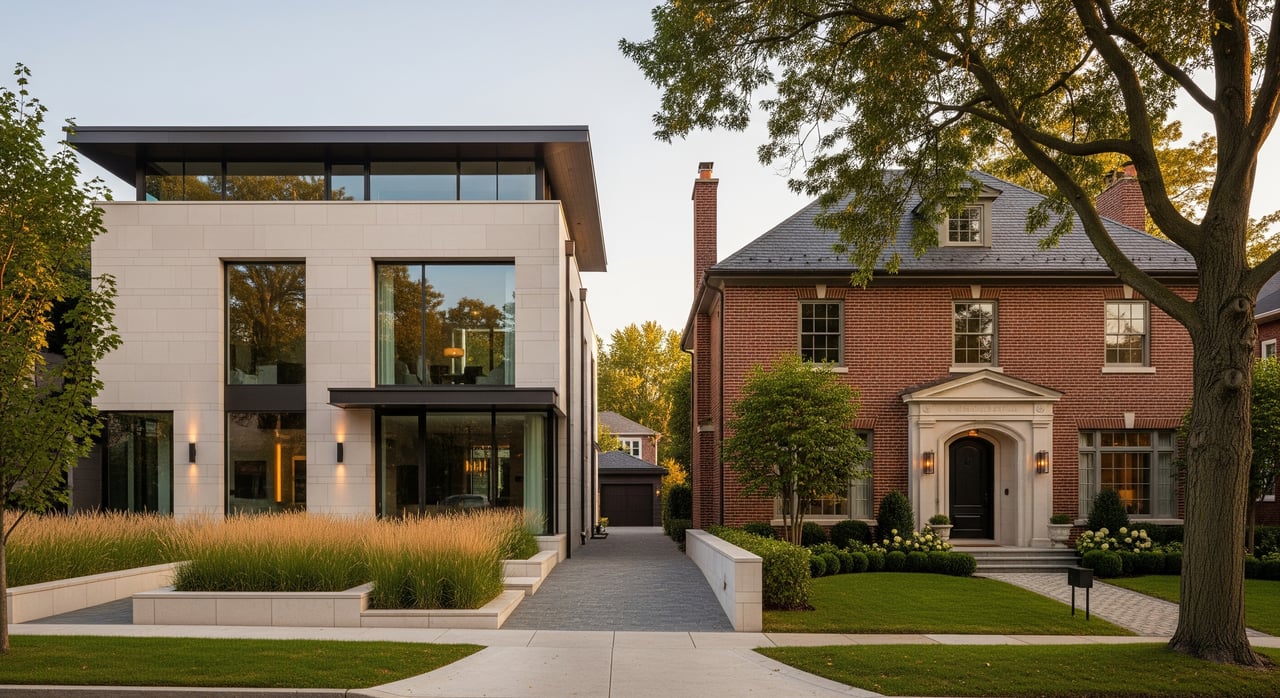
A Crain's Chicago Business report on this issue described one South Avenue property bought by a builder specifically as a teardown, even though a real estate broker involved in the deal said end-user buyers would have kept the home standing. That's the market in miniature. The same house, the same price range, means something completely different depending on who's bidding and what they intend, and nothing in the transaction itself locks that intent in place.
If you're looking at an older home in Glencoe, a few concrete steps are worth taking before you write an offer:
- Check the address against the Village's own Historic Glencoe Story-Map, which lists landmark status and architect of record where one is known, before you assume anything from the listing photos alone.
- Ask directly whether the property carries a pre-2013 Illinois property tax assessment freeze. A lingering freeze is itself a signal of legacy landmark status that may not be obvious from the listing.
- If a home carries no designation at all, plan around the mechanical reality of a teardown timeline rather than around good intentions: according to the Village of Glencoe, a minimum 60-day waiting period before demolition, plus 8 to 12 weeks of Village staff review on new construction plans before a demolition or building permit is issued.
- If you're buying specifically because you want to preserve a house, understand that only certified landmark status carries actual legal force. A sincere conversation with the seller, as Joshua Sachs learned, doesn't bind the next owner, and it doesn't bind the one after that either.
The Question Worth Asking First
None of this is a reason to avoid Glencoe's older housing stock. It's a reason to ask a different first question than most buyers do. Before you fall for the wainscoting or the wide-plank floors, find out which of the three tiers the house actually occupies, because that answer, not the listing description, is what determines whether you're buying a piece of Glencoe's architectural history or a piece of land with a house on it for now.
This is the kind of due diligence that rewards genuine local knowledge over a quick search on a national portal. The Dickstein Group has spent decades inside Glencoe's older neighborhoods, working through exactly these questions with sellers weighing a legacy property and buyers trying to understand what they're actually purchasing. If you're circling an older Glencoe home, or thinking about what your own older home is really worth in this environment, we'd welcome the conversation. Request a private consultation and we'll walk through it together.
A Few Quick Questions
Does landmark status lower a home's resale value? Not inherently. Some buyers pay a premium for verified architectural pedigree and the certainty that comes with it. Others see the renovation restrictions on a certified landmark as a limitation they'd rather avoid. The honest answer is that it depends heavily on who's shopping, which is exactly why understanding a property's actual designation, rather than assuming based on its age or style, matters before you price a purchase or a sale.
Can you still renovate a certified landmark home? Yes. Certified status doesn't freeze a house exactly as it stands. Exterior alterations go through a Certificate of Appropriateness review with the Preservation Commission rather than a standard permit, which is a different process than the outright prohibition that applies to demolishing or physically altering a certified landmark without that approval.
This article is general information, not legal, tax or financial advice. Consult a qualified professional about your situation.